

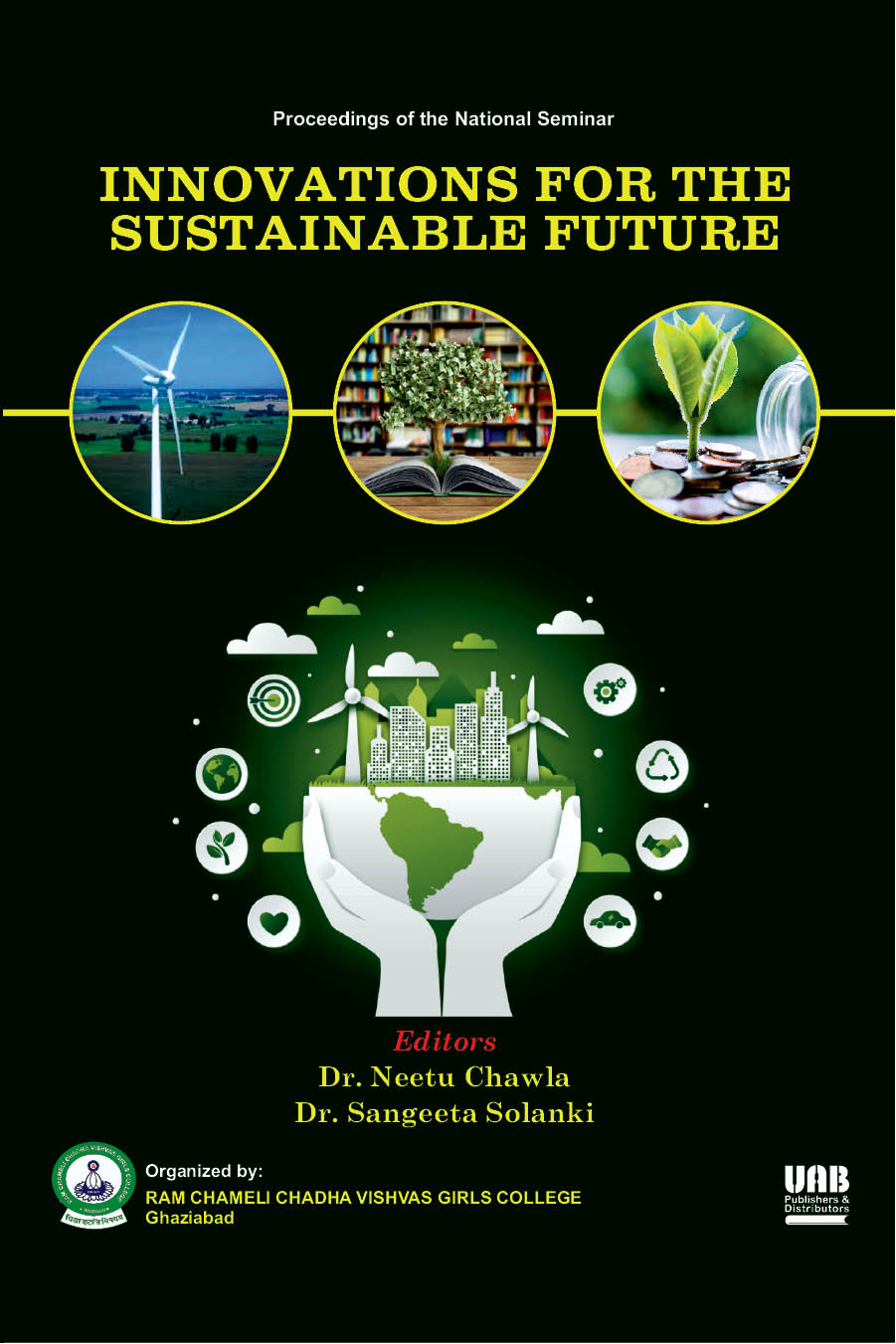
The Role of Education in Achieving the UN Sustainable Development Goals: An Indian Perspective by Pallavi Sharma and Prof. Dr. Neetu Chawla
Chapter – 6: The Role of Education in Achieving the UN Sustainable Development Goals: An Indian Perspective
Book Title: Innovations for the Sustainable Future: A Multidisciplinary Approach
DOWNLOAD
Description
Innovations for the Sustainable Future
Editors: Dr. Neetu Chawla and Dr. Sangeeta Solanki
Published by Universal Academic Books Publishers & Distributors,
New Delhi (India), ISBN: 978-81-994586-4-2, 2026
Chapter 6
The Role of Education in Achieving the UN Sustainable Development Goals: An Indian Perspective
Pallavi Sharma1 and Prof. Dr. Neetu Chawla2
1Assistant Professor (Teacher Education Department) and 2Principal, Ram Chameli Chadha Vishvas Girls College, Ghaziabad
Abstract
Education is universally acknowledged as the most effective instrument for fostering human development and achieving global sustainability. The United Nations Sustainable Development Goals (SDGs), adopted in 2015, provide a framework for global peace, prosperity, and environmental preservation by 2030. Among these, SDG 4—Quality Education—forms the foundation for realizing all other goals. This paper explores the pivotal role of education in advancing the SDGs, emphasizing India’s policy initiatives and the alignment between the National Education Policy (NEP) 2020 and the global sustainability agenda. Education serves both as a means and an end in sustainable development by empowering individuals with critical thinking, ethical values, and environmental consciousness. NEP 2020 promotes holistic and multidisciplinary learning, inclusive education, and value-based pedagogy—all of which strengthen India’s contribution toward achieving the SDGs. The paper further examines the challenges facing education for sustainable development (ESD) in India, such as inequity, teacher preparedness, and limited resources. It also highlights the role of teacher educators in promoting sustainability through pedagogy, research, and community engagement. The study concludes that aligning NEP 2020 with the SDG framework can transform education into a catalyst for achieving an equitable, inclusive, and sustainable society. Education also acts as a transformative force that bridges social, economic, and environmental dimensions of development. By fostering global citizenship and intercultural understanding, it empowers learners to participate meaningfully in creating a just and sustainable world. Thus, education, when aligned with the principles of the SDGs and NEP 2020, becomes the cornerstone for building a resilient and future-ready society.
Keywords: Sustainable Development Goals (SDGs), Quality Education, NEP 2020, Education for Sustainable Development (ESD), India, Inclusive Education, Environmental Sustainability, Teacher Education.
1. Introduction
Sustainable development has emerged as a defining global concern of the twenty-first century. The adoption of the United Nations 2030 Agenda in 2015 provided a universal framework for nations to address critical challenges such as poverty, inequality, environmental degradation, and climate change. Education plays an indispensable role in achieving these objectives, as it equips individuals with the knowledge, skills, and values necessary for creating sustainable societies (UNESCO, 2020). India, with its diverse population and complex educational landscape, recognizes education as the key to national progress. The National Education Policy (NEP) 2020 provides a transformative vision of reimagining education to meet the goals of equity, quality, and sustainability. This seminar paper examines how the Indian education system, under the guidance of NEP 2020, contributes to achieving the SDGs, particularly through the lens of teacher education. It also highlights the interlinkages between education, social inclusion, and economic empowerment in building a sustainable future. By aligning national education goals with global sustainability priorities, India seeks to create a generation of responsible, skilled, and environmentally conscious citizens. Furthermore, teacher education institutions (TEIs) are envisioned as vital platforms for integrating sustainability concepts into pedagogy and practice. In doing so, the Indian education system not only supports national development but also contributes meaningfully to the global pursuit of the Sustainable Development Goals.
Additional information
| Book Title | Innovations for the Sustainable Future: A Multidisciplinary Approach |
|---|---|
| Chapter | Chapter 6 – The Role of Education in Achieving the UN Sustainable Development Goals: An Indian Perspective |
| Page Nos. | 47-54 |
| DOI | 10.66788/9788199458642/6 |
You may also like…
-
- Sale!
Innovations for the Sustainable Future: A Multidisciplinary Approach by Neetu Chawla and Sangeeta Solanki
- Price range: ₹1,990 through ₹2,650
- Select options This product has multiple variants. The options may be chosen on the product page
Reviews
There are no reviews yet.