

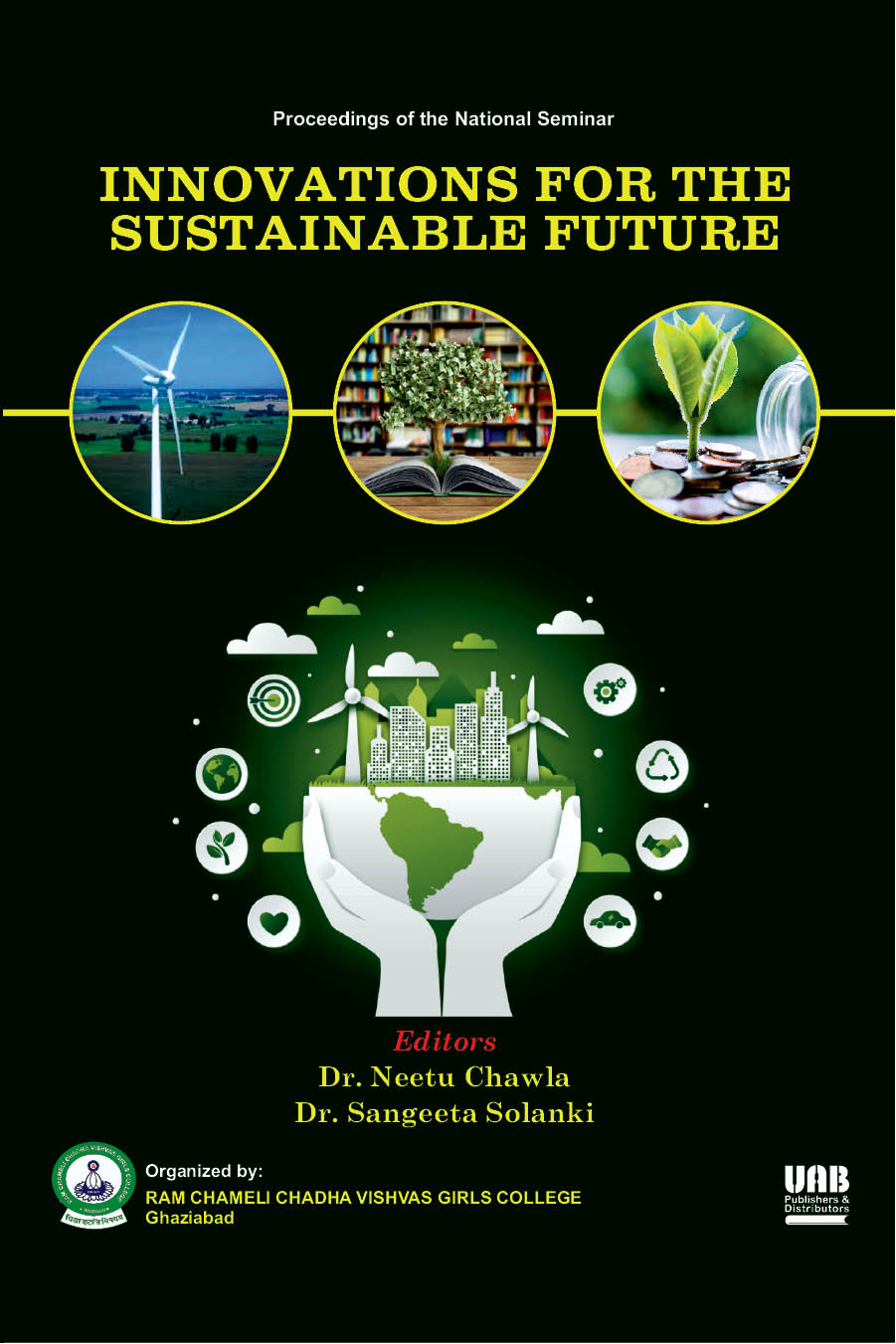
AI Modelling of Pollution Stress on Insect Growth and Development by Dr. Mamta Sharma and Megha Chaudhary
Chapter – 24: AI Modelling of Pollution Stress on Insect Growth and Development
Book Title: Innovations for the Sustainable Future: A Multidisciplinary Approach
Description
Innovations for the Sustainable Future
Editors: Dr. Neetu Chawla and Dr. Sangeeta Solanki
Published by Universal Academic Books Publishers & Distributors,
New Delhi (India), ISBN: 978-81-994586-4-2, 2026
Chapter 24
AI Modelling of Pollution Stress on Insect Growth and Development
Dr. Mamta Sharma1 and Megha Chaudhary2
1Associate Professor and 2Scholar, Ram Chameli Chadha Vishvas Girls College, Ghaziabad
Abstract
Insects are among the most abundant, diverse, and ecologically important organisms on Earth. They play vital roles in pollination, nutrient recycling, and maintaining the balance of ecosystems. However, the modern era of industrialization and urbanization has led to a massive increase in environmental pollution, which has started to affect insect growth, physiology, and survival. Various types of pollutants such as heavy metals, pesticides, and air contaminants interfere with normal insect metabolism, hormonal regulation, and reproductive efficiency. These changes often result in slower larval development, reduced body size, and lower adult emergence rates.
Studying these complex biological effects through traditional experimental methods is time-consuming and limited by environmental variability. Hence, the use of Artificial Intelligence (AI) modelling has emerged as a powerful modern approach in zoological research. AI-based systems, especially neural networks and machine learning algorithms, can process large biological datasets and predict how different levels or combinations of pollutants influence insect growth and development. By integrating biological observations with computational simulations, AI models can analyze patterns that are difficult to identify through manual methods.
In this research, AI modelling has been applied to simulate the effects of pollution stress on various insect species such as Drosophila melanogaster, Bombyx mori, and Tenebrio molitor. The model effectively predicts changes in growth parameters like larval duration, pupal weight, and adult emergence rates under different pollution conditions. The results show that pollution significantly delays developmental time, increases mortality, and decreases adult fitness. The AI models achieved over 85–90% accuracy in prediction, which proves that artificial intelligence can serve as a reliable and efficient tool for environmental and zoological studies.
This study highlights the importance of combining biology and technology to address current ecological challenges. AI modelling not only saves time and experimental cost but also helps predict future risks to insect biodiversity caused by environmental pollution. Such approaches can ultimately contribute to better environmental management, conservation strategies, and sustainable ecological balance.
Keywords: Insects, Pollution stress, AI modelling, Machine learning, Growth, Development, Environment.
1. INTRODUCTION
Insects Are the Most Numerous And diverse group of living organisms on Earth, occupying almost every type of habitat from soil and forests to freshwater and even polluted environments. They are essential for ecological balance as they act as pollinators, decomposers, prey for many species, and indicators of environmental health. Begon, M., Townsend, C. R., & Harper, J. L. (2006). Their life processes—growth, development, reproduction, and survival—are deeply influenced by environmental factors such as temperature, humidity, and food availability. In recent decades, however, these natural conditions have been increasingly disturbed due to rapid industrialization, urban expansion, and agricultural chemical use. This has introduced different kinds of pollution into the ecosystem, causing severe stress to insect populations.
Additional information
| Book Title | Innovations for the Sustainable Future: A Multidisciplinary Approach |
|---|---|
| Chapter | Chapter – 24: AI Modelling of Pollution Stress on Insect Growth and Development |
| Page Nos. | 201-207 |
| DOI | 10.66788/9788199458642/24 |
You may also like…
-
- Sale!
Innovations for the Sustainable Future: A Multidisciplinary Approach by Neetu Chawla and Sangeeta Solanki
- Price range: ₹1,990 through ₹2,650
- Select options This product has multiple variants. The options may be chosen on the product page
Reviews
There are no reviews yet.