

Guarding Both Sides of Justice: Legal Reforms to Address Misuse of Women Centric Laws While Strengthening Protection for Women Against Violence
₹500
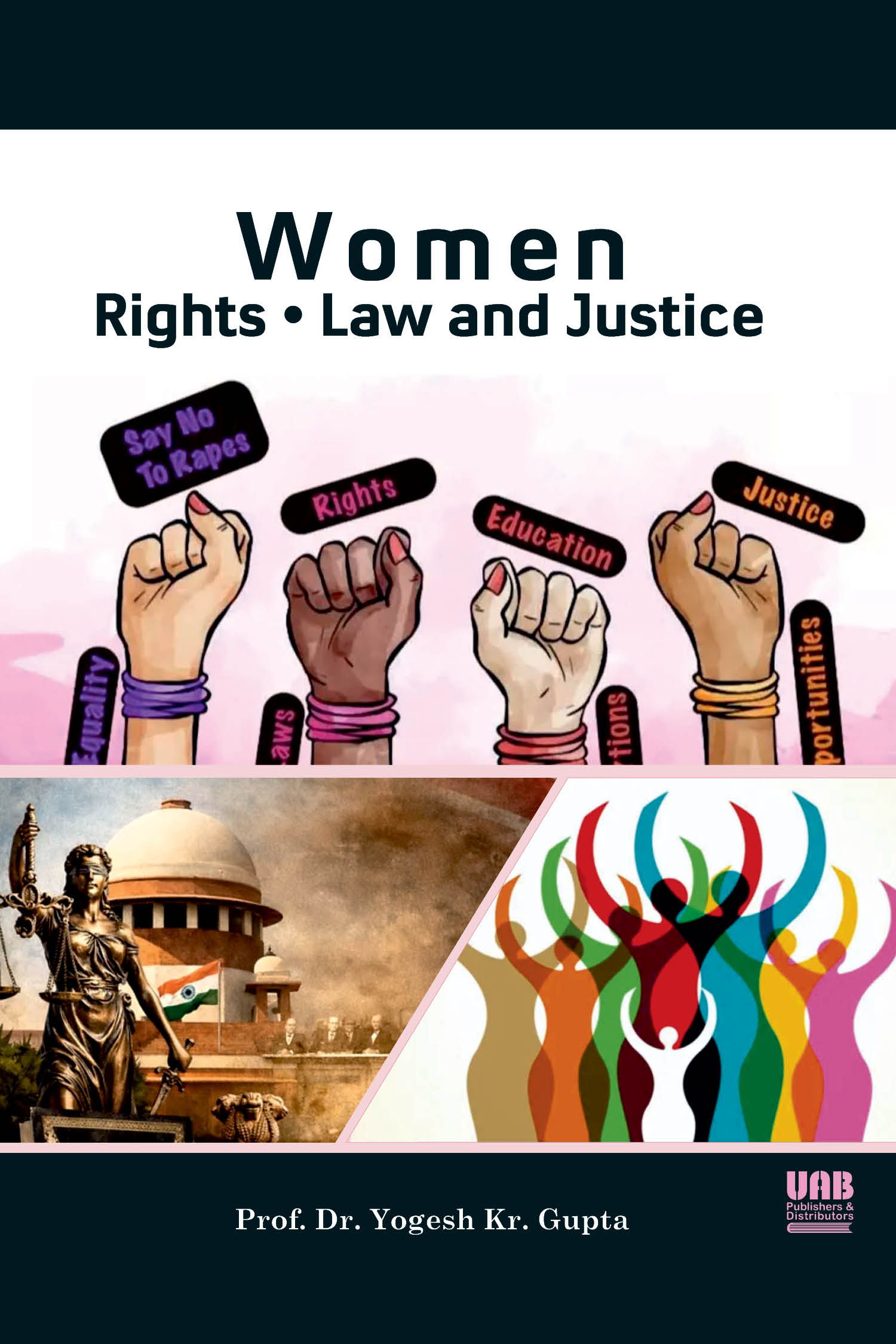
Book Title: Women Rights, Laws and Justice
Chapter 24: Guarding Both Sides of Justice: Legal Reforms to Address Misuse of Women Centric Laws While Strengthening Protection for Women Against Violence
Author: Adv. Kavita N. Solunke
Description
Women Rights, Law and Justice
Editor: Prof. Dr. Yogesh Kumar Gupta
Published by Universal Academic Books Publishers and Distributors,
New Delhi (India)
ISBN: 978-81-686113-2-0, 2026
Chapter 24
Guarding Both Sides of Justice: Legal Reforms to Address Misuse of Women Centric Laws While Strengthening Protection for Women Against Violence
Adv. Kavita N. Solunke
(BA, BSL, LLM, MBA, GDC&A, PG(ADR), STAR CCIO)
Additional Government Pleader, Arbitrator, Mediator& Conciliator High Court of Bombay & Notary, Government of India
Abstract
Women centric criminal laws in India, such as Section 498A of the Indian Penal Code (IPC) on cruelty, dowry related offences, and domestic violence provisions, were introduced to confront entrenched gender based violence and chronic under reporting. Over time, however, a powerful counter narrative of “misuse” has emerged, focusing on allegations of false or exaggerated complaints, omnibus implication of relatives, and strategic use of criminal law in matrimonial disputes. Recent Supreme Court decisions, especially in 2024-2025 on Section 498A IPC and dowry related offences, demonstrate judicial concern about both wrongful criminalisation and the continuing severity of violence against women.
This paper argues that the appropriate response is not to dilute women protective laws, but to adopt targeted legal and institutional reforms that reduce misuse while preserving strong remedies for genuine victims. Drawing on recent case law such as Dara Lakshmi Narayana v. State of Telangana (2024), Achin Gupta v. State of Haryana (2024), and the Supreme Court’s evolving guidelines on dowry related violence, as well as earlier precedents including Arnesh Kumar v. State of Bihar, the paper proposes a reform package centred on: (i) codified arrest standards; (ii) structured triage and voluntary mediation in appropriate cases; (iii) safeguards against omnibus implication of distant relatives; (iv) victim centred support systems; and (v) data-driven law-making. It concludes that “guarding both sides of justice” – protecting women from violence and accused persons from procedural abuse – is possible only through calibrated reforms that are evidence based, gender sensitive and institutionally grounded.
Keywords
Women Centric Laws; Section 498A IPC; Dowry Related Violence; Domestic Violence; Misuse of Law; Legal Reforms; Supreme Court of India; Due Process; Gender Justice; Criminal Justice System; India.
1. Introduction
The criminal law response to violence against women in India has undergone major transformation over the last four decades, from the insertion of Section 498A IPC in 1983 and the strengthening of the Dowry Prohibition Act (DPA), to the Protection of Women from Domestic Violence Act, 2005 and the post Nirbhaya reforms in 2013. These changes were driven by feminist advocacy, shocking cases of cruelty and dowry deaths, and sustained criticism of a state that had long ignored gender based violence.
Additional information
| Book Title | Women Rights, Law and Justice |
|---|---|
| Chapter | Chapter 24: Guarding Both Sides of Justice: Legal Reforms to Address Misuse of Women Centric Laws While Strengthening Protection for Women Against Violence by Adv. Kavita N. Solunke |
| Page Nos. | 197-205 |
| DOI | 10.66788/9788168611320/24 |
Related products
-

-
Sale!
Comprehensive Natural Products Chemistry
- Original price was: ₹18,918.₹15,134Current price is: ₹15,134.
- Add to cart
-
Sale!
-
-
Sale!
Applied Biosensors
- Original price was: ₹7,799.₹6,239Current price is: ₹6,239.
- Add to cart
-
Sale!
-
-
Sale!
Forest Products
- Original price was: ₹4,335.₹3,468Current price is: ₹3,468.
- Add to cart
-
Sale!
Reviews
There are no reviews yet.