

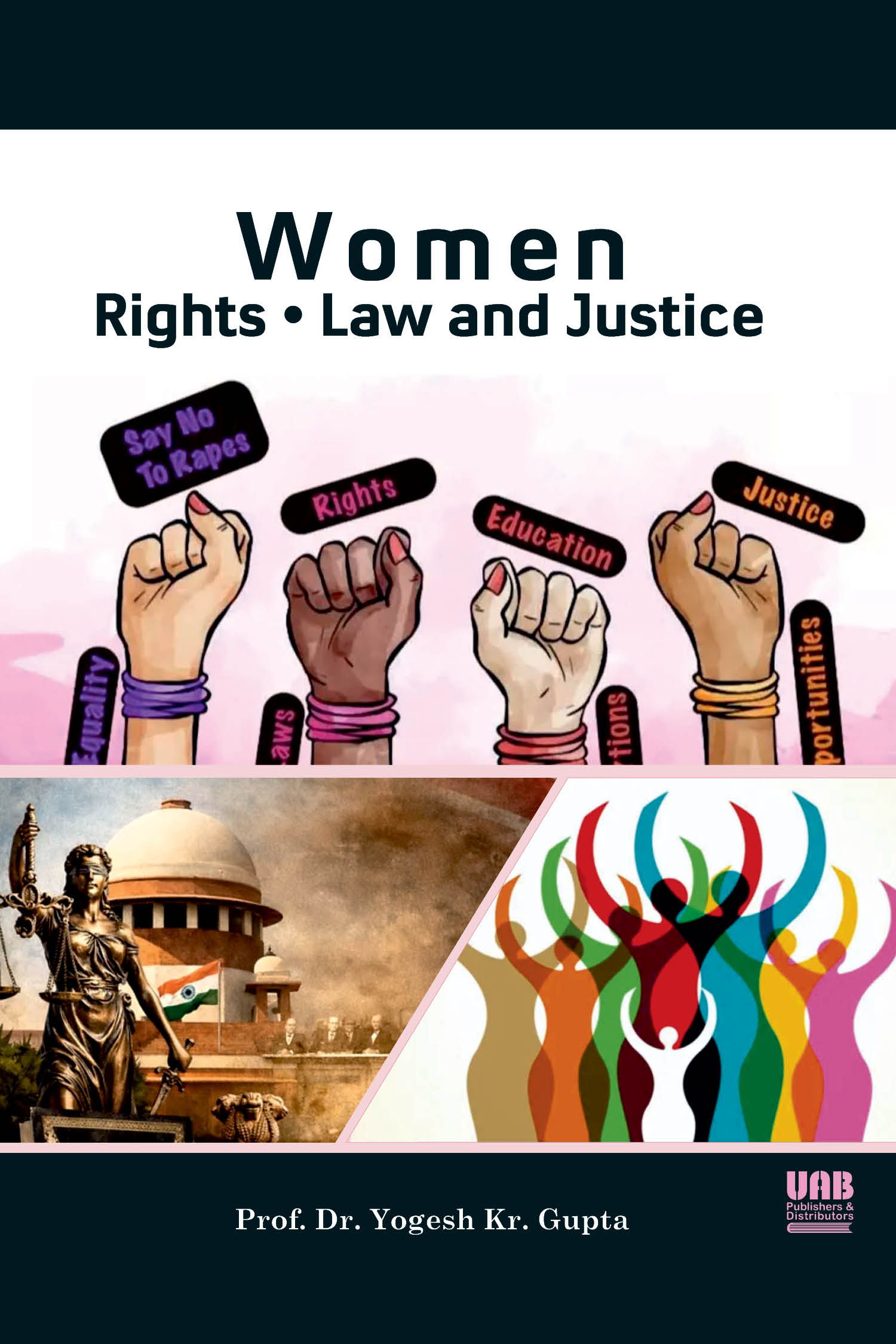
Uniform Civil Code and Women’s Rights in India: Constitutional Ideals, Judicial Interventions, and Contemporary Debates
₹500
Chapter 15: Uniform Civil Code and Women’s Rights in India: Constitutional Ideals, Judicial Interventions, and Contemporary Debates
Author: Dr. K. Bhaskar
Book Title: Women Rights, Laws and Justice
Description
Women Rights, Law and Justice
Editor: Prof. Dr. Yogesh Kumar Gupta
Published by Universal Academic Books Publishers and Distributors,
New Delhi (India)
ISBN: 978-81-686113-2-0, 2026
Chapter 15
Uniform Civil Code and Women’s Rights in India: Constitutional Ideals, Judicial Interventions, and Contemporary Debates
Dr. K. Bhaskar
Associate Professor of Political Science, Government City College (A), Hyderabad
Abstract
The debate on the Uniform Civil Code (UCC) in India represents one of the most enduring constitutional and socio-legal dilemmas in the country’s democratic journey. Rooted in Article 44 of the Constitution as a Directive Principle of State Policy, the UCC seeks to establish a uniform legal framework governing marriage, divorce, inheritance, and adoption across all religious communities. However, the persistence of religious diversity, legal pluralism, and socio-cultural complexities has rendered its implementation highly contentious.
This chapter critically examines the relationship between the UCC and women’s rights in India by situating the debate within the broader framework of constitutional ideals, judicial interventions, and contemporary political discourse. It analyses the historical evolution of personal laws, the persistence of gender inequalities within these systems, and the role of the judiciary in advancing gender justice. Attention is given to landmark Supreme Court judgments that have shaped public debate and highlighted the need for reform.
The chapter further explores the tensions between gender equality and minority rights, while engaging with comparative insights such as the Goan model. It argues that the question is not merely about legal uniformity but about ensuring substantive equality and dignity for women. The study concludes that a calibrated and context-sensitive approach—combining legal reform, judicial activism, and social engagement—is essential for reconciling constitutional values with India’s plural social fabric.
Keywords
Uniform Civil Code, Women’s rights, Gender justice, Personal laws, Constitutional equality.
1. Introduction
The question of whether India should adopt a Uniform Civil Code (UCC) continues to occupy a central place in constitutional debates and public discourse. The idea of a uniform set of civil laws applicable to all citizens, irrespective of religion, was envisaged by the framers of the Constitution as a long-term objective aimed at promoting national integration and legal equality (Austin, 1966). However, more than seven decades after independence, the issue remains unresolved, reflecting the complexities inherent in balancing constitutional ideals with social realities.
Additional information
| Book Title | Women Rights, Laws and Justice |
|---|---|
| Chapter | Chapter 15: Uniform Civil Code and Women’s Rights in India: Constitutional Ideals, Judicial Interventions, and Contemporary Debates by Dr. K. Bhaskar |
| Page Nos. | 123-130 |
| DOI | 10.66788/9788168611320/15 |
Related products
-

-
Sale!
Biotechnology of Filamentous Fungi
- Original price was: ₹7,799.₹6,239Current price is: ₹6,239.
- Add to cart
-
Sale!
-
-
Sale!
Essentials of Management information Systems
- Original price was: ₹4,339.₹3,471Current price is: ₹3,471.
- Add to cart
-
Sale!
-
-
Sale!
Dairy Modernization
- Original price was: ₹10,672.₹8,538Current price is: ₹8,538.
- Add to cart
-
Sale!
Reviews
There are no reviews yet.