


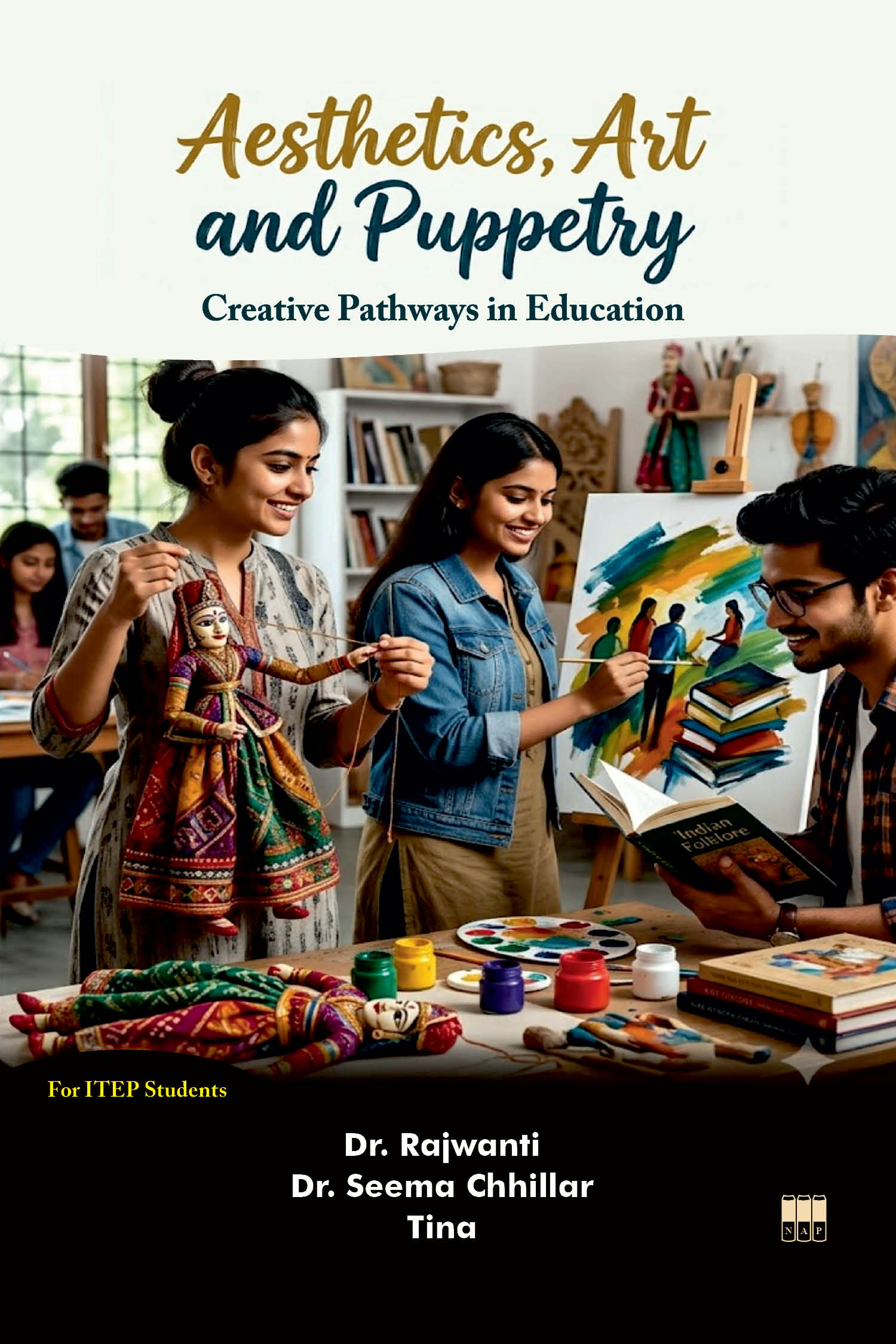
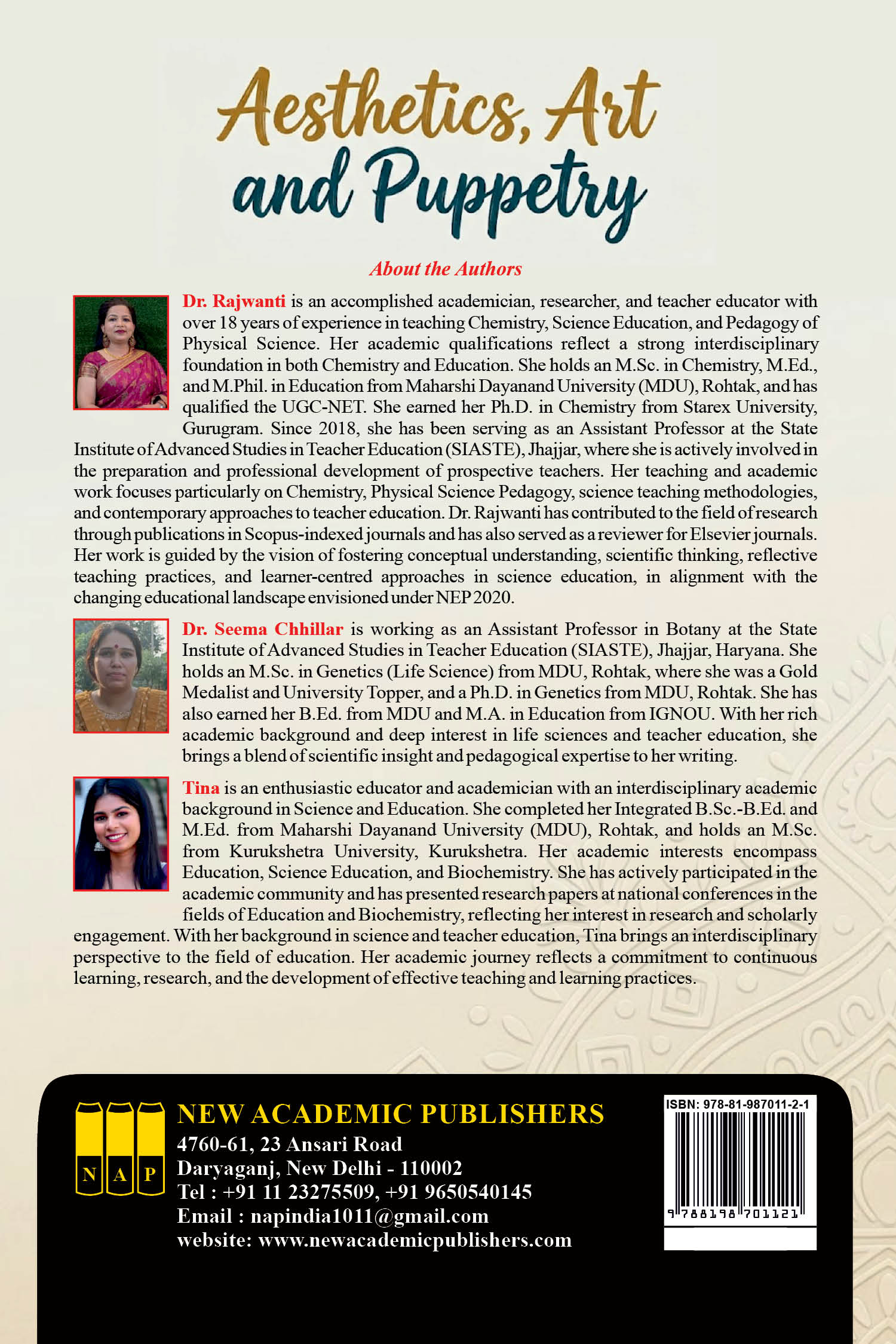
Aesthetics, Art and Puppetry: Creative Pathways in Education by Dr. Rajwanti et al.
Original price was: ₹349.₹275Current price is: ₹275.
The book “Aesthetics, Art and Puppetry: Creative Pathways in Education” A Pedagogical Handbook for Teacher-trainees. This handbook is based on the course “Art Education (Performing and Visual) and Creative Expressions, Puppetry-Art”. The original course included learning objectives, three major units, teaching methods, a weekly session plan, and suggested reading material. This companion volume helps trainers and facilitators quickly grasp the handbook’s structure and practical tools.
15 in stock
Description
Title: Aesthetics, Art and Puppetry: Creative Pathways in Education
Authors: Dr. Rajwanti, Dr. Seema Chhillar and Tina
Preface
About the Book
Chapter 1: Aesthetics and Art Education – Importance and Dimensions 1
1.1. Introduction 1
1.2. Meaning of Aesthetic Education 1
1.3. Meaning of Art Education 2
1.4. Objectives of Aesthetic and Art Education 3
1.5. Importance of Aesthetic and Art Education 3
1.6. Dimensions of Aesthetic and Art Education 6
1.7. Major Forms of Art Education 9
1.8. Role of the Teacher in Aesthetic and Art Education 9
1.9. Integration of Art with Other School Subjects 10
1.10. Methods and Activities for Aesthetic and Art Education 10
1.11. Assessment in Art and Aesthetic Education 11
1.12. Challenges in Aesthetic and Art Education 12
1.13. Principles of Effective Aesthetic and Art Education 12
1.14. Aesthetic and Art Education in Holistic Development 16
1.15. Puppetry and Aesthetic Education 16
1.16. Defining Aesthetics: Judgment, Form, and Feeling 17
1.17. The Aesthetic Dimension in a Child’s Everyday Life 18
1.18. Three Aspects of Art in Education 19
1.19. A Closer Look at Aesthetic Development in the Early Years 20
1.20. Giving Children an Observational Vocabulary 21
1.21. From Abstract Aesthetics to Primary Practice 22
1.22. Common Misconceptions about Aesthetics in the Classroom 23
Review Questions 24
Chapter 2: Aesthetic and Art Education at the Primary Level 25
2.1. What makes primary education a distinct case? 25
2.2. Art and Language: Expression before Interpretation 25
2.3. Play, Imagination, and the Origins of Performance 26
2.4. Making Room for Art in the Curriculum: Competing Pressures 26
2.5. Inclusion and Differentiation in Primary Art Activities 27
2.6. Art Education in the Context of the National Education Policy 2020 (NEP 2020) and Teacher Education 28
Review Questions 29
Chapter 3: The World of Puppetry 31
3.1. Puppetry as a Performing Art 31
3.2. A Brief History of Puppetry 31
3.3. The Main Types of Puppetry and the Reasoning Behind Them 32
3.4. Why Puppetry Fits an Art-Education Curriculum 33
3.5. Puppetry and Related Performing Arts 34
3.6. The Puppet as an Object of Study: Materials across Traditions 34
3.7. Puppetry, Ritual, and Community: A Broader Cultural Framework 35
Review Questions 35
Chapter 4: Principles of Puppet Design 37
4.1. Design before Construction: Imagination and Visualization 37
4.2. Visualizing Use: Designing for the Performance Context 38
4.3. Materials, Joining Methods, and Durability 38
4.4. Costume, Character, and Accessories 39
4.5. Common Design Difficulties and How to Handle Them 39
4.6. A Design Framework for the Classroom 40
4.7. Safety Considerations in Puppet Making 40
4.8. Color, Proportion, and Legibility in Puppet Design 40
4.9. Puppet Design as Problem-Solving 41
Review Questions 41
Chapter 5: A Scaffolded Construction Sequence 44
5.1. The Logic of the Sequence 44
5.2. Stage One: Finger Puppets 44
5.3. Stage Two: Small Paper Shapes (Fish, Bird, Mouse) 45
5.4. Stage Three: Masks — Flat and Dimensional 45
5.5. Stage Four: Puppets from Old Newspaper 46
5.6. Pacing within Limited Session Time 47
5.7. Reading the Sequence as a Model for Curriculum Design 47
5.8. Documenting the Construction Process 48
5.9. Comparing the Sequence to Alternative Construction Orders 48
5.10. The Newspaper Puppet as a Lesson in Sustainability 48
Review Questions 48
Chapter 6: Performance, Voice, and Collaboration 51
6.1. From Object to Living Character 51
6.2. From Construction to Animation 51
6.3. Movement as Character 52
6.4. Voice as the Life of the Puppet 52
6.5. Synchronization of Voice and Movement 53
6.6. Developing Character Personality 53
6.7. Communication with the Audience 53
6.8. The Protective Distance of the Puppet 53
6.9. Story First: Building an Engaging Narrative 54
6.10. Character 54
6.11. Objective or Goal 54
6.12. Obstacle or Complication 55
6.13. Attempts and Action 55
6.14. Resolution 55
6.15. Storytelling through Dialogue 56
6.16. Narration and the Puppet Performance 56
6.17. Beginning, Middle, and End 56
6.18. Story, Value, and Learning 57
6.19. Adapting Stories for Puppetry 57
6.20. Audience Engagement 57
6.21. From Story to Performance 58
6.22. Voice, Movement, and the Puppet’s Physical Life 58
6.23. The Puppet’s Protective Distance 59
6.24. From Solo to Pairs to Groups: A Collaborative Progression 59
6.25. Managing Performance Anxiety 60
6.26. Reflection and Consolidation 60
6.27. Puppetry and Language Development: A Closer Look 60
6.28. Puppetry and Emotional Literacy 60
6.29. Audience Skills: Watching Well is Part of Performing 61
6.30. The Puppet Show as an Assessment-Free Space 61
6.31. Puppetry Beyond the Twelve Sessions: Continued Use in the Classroom 61
Review Questions 62
Chapter 7: Experiential Teaching Systems in Art Education 64
7.1. ‘Hands-on Training’: Unpacking a Deceptively Simple Phrase 64
7.2. Learning by Doing: An Epistemological Claim 64
7.3. The Facilitator’s Role 65
7.4. Balancing Structure and Creative Freedom 65
7.5. Situating This Course within Broader Learning Theory 65
7.6. Connecting Practice to Theory: A Note for Teacher-Educators 66
7.7. Managing a Mixed-Method Course 66
7.8. Documenting and Sharing Experiential Learning 66
Review Questions 67
Chapter 8: Classroom Transfer, Session Planning, and Assessment 69
8.1. From Course to Classroom: A Discussion of Transfer 69
8.2. Adapting the Sequence to Different Classroom Constraints 69
8.3. Cross-Curricular Applications 70
8.4. The Twelve-Session Structure: An Annotated Reference 70
8.5. Assessment: Principles and Practical Approaches 71
8.6. Working with Limited Facilitator Experience 72
8.7. A Closing Checklist for Course Facilitators 72
8.8. Closing Reflection 72
Review Questions 73
Suggested Reading 75
Additional information
| Weight | 0.3 kg |
|---|---|
| Dimensions | 23.25 × 6.25 × 0.25 cm |
| Author | Dr. Rajwanti, Dr. Seema Chhillar, Tina |
| ISBN | 9788198701121 |
| Publisher | New Academic Publishers |
| Book Type | |
| size | 6 x 9 |
| Year | 2026 |
Related products
-

-
Sale!
Advanced Semiconductor and Organic Nano-techniques: Tunable bandgaps and nanotubes
- Original price was: ₹4,331.₹3,465Current price is: ₹3,465.
- Add to cart
-
Sale!
-
-
Sale!
European Economic Integration
- Original price was: ₹13,872.₹11,098Current price is: ₹11,098.
- Add to cart
-
Sale!
-
-
Sale!
Biology of Bacilli
- Original price was: ₹7,799.₹6,239Current price is: ₹6,239.
- Add to cart
-
Sale!
Reviews
There are no reviews yet.