

International Covenants and India’s Commitment to Women’s Rights
₹500
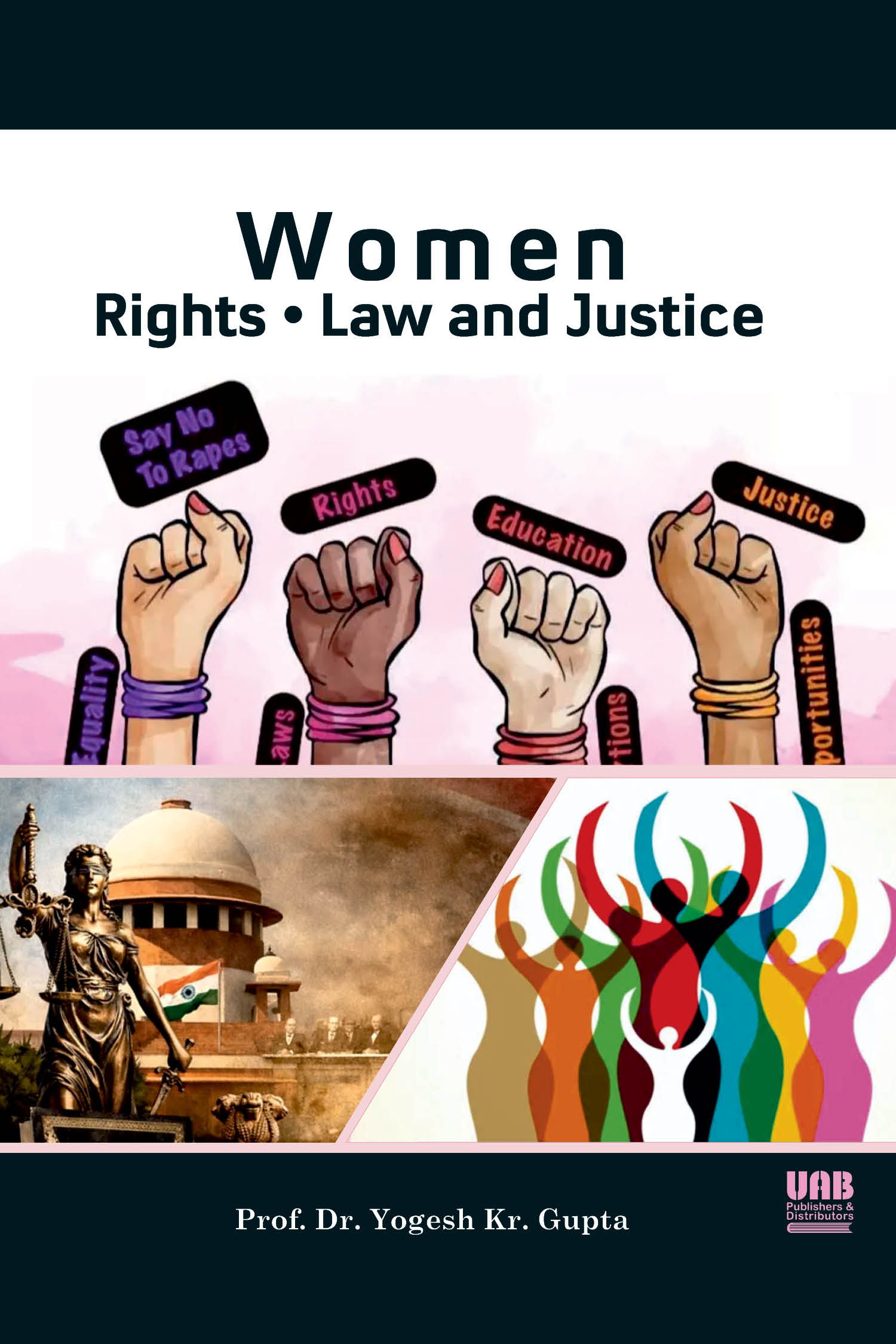
Book Title: Women Rights, Laws and Justice
Chapter 34: International Covenants and India’s Commitment to Women’s Rights
Author: Ankita
Description
Women Rights, Law and Justice
Editor: Prof. Dr. Yogesh Kumar Gupta
Published by Universal Academic Books Publishers and Distributors,
New Delhi (India)
ISBN: 978-81-686113-2-0, 2026
Chapter 34
International Covenants and India’s Commitment to Women’s Rights
Ankita
Research Scholar, Department OF Law, University OF Jammu, Jammu & Kashmir
Abstract
Women’s rights have emerged as a fundamental component of international human rights law, with the principles of equality, dignity, and non-discrimination forming the basis of global legal protection. This chapter examines the relationship between international human rights instruments and India’s constitutional and legal framework for protecting women’s rights. It analyses the evolution of international standards through the Universal Declaration of Human Rights (1948), the International Covenant on Civil and Political Rights (1966), the International Covenant on Economic, Social and Cultural Rights (1966), the Convention on the Elimination of All Forms of Discrimination against Women (1979), and the Beijing Declaration and Platform for Action (1995). The study further evaluates India’s commitment to these international obligations by examining constitutional guarantees, legislative measures, and judicial interpretation. Particular emphasis is placed on the transformative role of the Supreme Court of India in harmonising international norms with domestic constitutional principles through landmark decisions such as Vishaka v. State of Rajasthan, Suchita Srivastava v. Chandigarh Administration, Joseph Shine v. Union of India, and Secretary, Ministry of Defence v. Babita Puniya. The chapter also identifies continuing challenges, including gender-based violence, workplace discrimination, unequal access to justice, socio-cultural barriers, and institutional limitations that hinder the effective implementation of women’s rights. It further discusses emerging concerns relating to cyber violence, artificial intelligence, climate change, migration, and reproductive rights. The chapter concludes that although India has established a comprehensive constitutional and legislative framework consistent with international standards, effective implementation requires stronger institutional mechanisms, gender-responsive governance, improved enforcement, and sustained policy reforms to achieve substantive gender equality and fulfil international human rights commitments.
Keywords
Women’s Rights; CEDAW; ICCPR; ICESCR; Gender Equality; Constitution of India; International Human Rights; Judicial Activism.
1. Introduction
Women’s rights constitute an indispensable component of the international human rights framework and are founded upon the principles of equality, dignity, liberty, and non-discrimination. These rights encompass civil, political, economic, social, and cultural freedoms that enable women to participate equally in every sphere of public and private life. Historically, however, women have experienced systemic discrimination, unequal access to resources, and exclusion from decision-making due to deeply entrenched patriarchal norms. Recognizing these inequalities, the international community has progressively developed legal instruments to eliminate discrimination and promote substantive gender equality.
Additional information
| Book Title | Women Rights, Law and Justice |
|---|---|
| Chapter | Chapter 34: International Covenants and India’s Commitment to Women’s Rights by Ankita |
| Page Nos. | 290-298 |
| DOI | 10.66788/9788168611320/34 |
Related products
-

-
Sale!
Biotechnology of Filamentous Fungi
- Original price was: ₹7,799.₹6,239Current price is: ₹6,239.
- Add to cart
-
Sale!
-
-
Sale!
Child Development
- Original price was: ₹2,604.₹2,083Current price is: ₹2,083.
- Add to cart
-
Sale!
-
-
Sale!
Food safety assurance and veterinary public health
- Original price was: ₹11,458.₹9,166Current price is: ₹9,166.
- Add to cart
-
Sale!
Reviews
There are no reviews yet.