

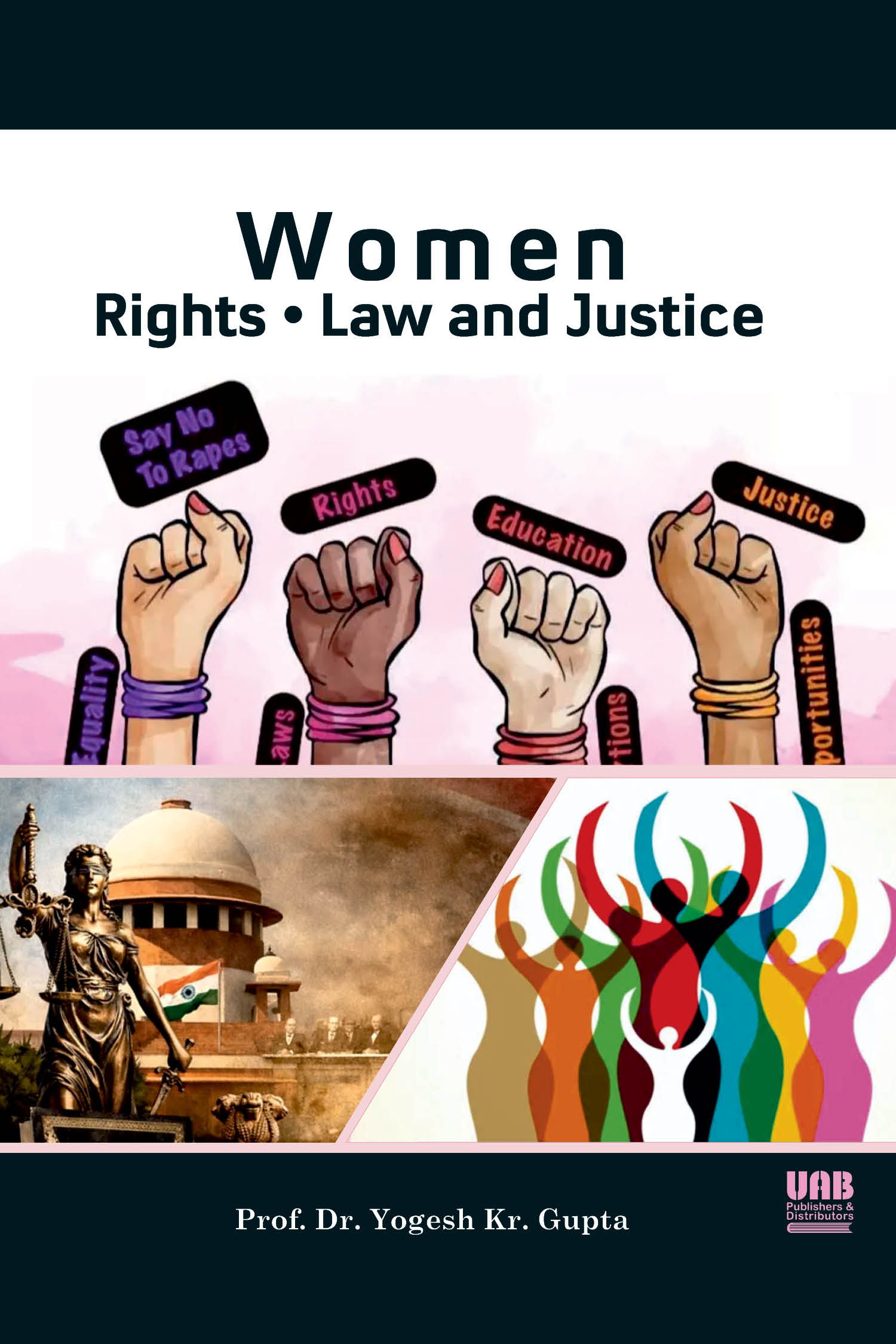
Beyond Formal Equality: An Intersectional Analysis of Women’s Rights and Justice in India
₹500
Book Title: Women Rights, Laws and Justice
Chapter 32: Beyond Formal Equality: An Intersectional Analysis of Women’s Rights and Justice in India
Author: Anjali Tomar
Description
Women Rights, Law and Justice
Editor: Prof. Dr. Yogesh Kumar Gupta
Published by Universal Academic Books Publishers and Distributors,
New Delhi (India)
ISBN: 978-81-686113-2-0, 2026
Chapter 32
Beyond Formal Equality: An Intersectional Analysis of Women’s Rights and Justice in India
Anjali Tomar
Student LLB, IAMR Law college, Ghaziabad, (CCS University, Meerut),
MA (Political Science), IGNOU, Delhi
Abstract
Women’s rights in India are shaped by a complex legal system that includes constitutional provisions, statutory laws, judicial interpretations, and international commitments. Despite this extensive framework, deep-rooted inequalities continue to affect women across social, economic, and legal domains. Women experience greater challenges in areas such as environmental degradation, disability, migration, economic vulnerability, and access to justice.
This paper argues that understanding equality only in formal terms is inadequate. Women’s rights must instead be analysed through an intersectional lens that considers overlapping disadvantages such as caste, class, disability, and migration status. The study focuses on five interconnected areas: environmental justice, rights of women with disabilities, social security and care, migration and refugee rights, and restorative justice.
By examining historical developments from ancient to modern India, important judicial decisions, and comparative legal perspectives from Western countries, this paper highlights the gap between legal guarantees and lived realities. It concludes that achieving genuine justice requires substantive equality, strong institutional accountability, and gender-responsive legal reforms.
Keywords
Women’s rights, Gender equality, Intersectional justice, Environmental justice, Women with disabilities, social security, Migration and refugees, Access to justice, Restorative justice, Constitutional law, Gender-responsive reforms, Substantive equality
1. Introduction
Women’s rights are essential for building a fair, inclusive, and just society. In India, however, these rights are not fully realized. Despite constitutional guarantees, women continue to face barriers in accessing education, employment, property, and justice systems. Violence against women remains widespread, and socio-economic inequalities further restrict their independence (Nigam, 2005).
The Indian Constitution guarantees equality through Articles 14, 15, and 16, yet these provisions often operate within a deeply patriarchal social structure. As highlighted by Herklotz (2018), decision-making processes related to women’s rights are still largely dominated by men, which directly affects how laws are implemented and enforced.
Additional information
| Book Title | Women Rights, Law and Justice |
|---|---|
| Chapter | Chapter 32: Beyond Formal Equality: An Intersectional Analysis of Women’s Rights and Justice in India by Anjali Tomar |
| Page Nos. | 272-279 |
| DOI | 10.66788/9788168611320/32 |
Related products
-

-
Sale!
Applied Biosensors
- Original price was: ₹7,799.₹6,239Current price is: ₹6,239.
- Add to cart
-
Sale!
-
-
Sale!
Advances in Food and Nutrition Research
- Original price was: ₹17,774.₹14,219Current price is: ₹14,219.
- Add to cart
-
Sale!
-
-
Sale!
Advanced Polymer Composites and Polymers in the Civil Infrastructure
- Original price was: ₹22,542.₹18,034Current price is: ₹18,034.
- Add to cart
-
Sale!
Reviews
There are no reviews yet.