

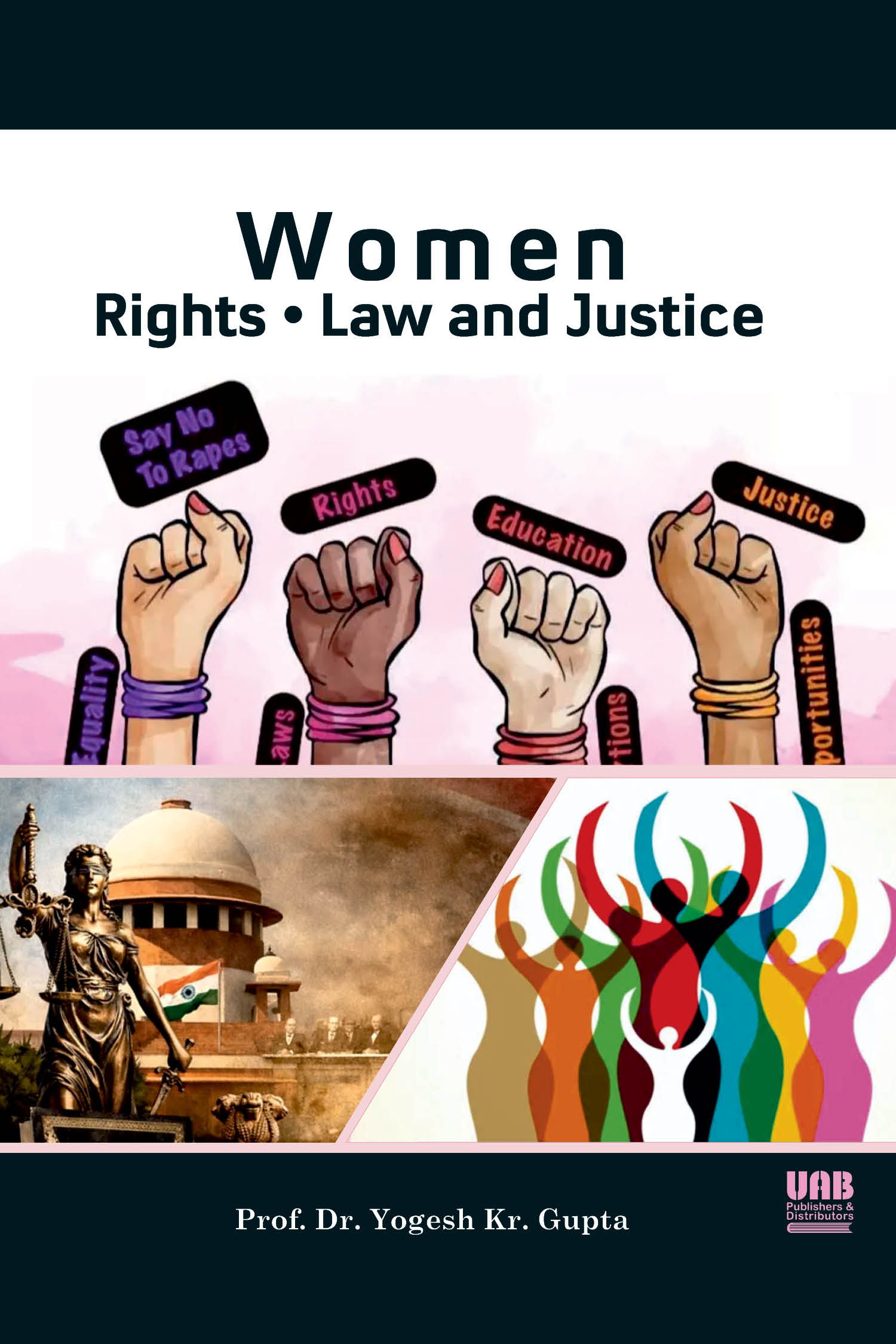
Women’s Rights Under Hindu, Muslim, and Christian Personal Laws: A Comparative Legal Analysis
₹500
Book Title: Women Rights, Laws and Justice
Chapter 31: Women’s Rights Under Hindu, Muslim, and Christian Personal Laws: A Comparative Legal Analysis
Author: Shahana Khan and Aayan Ali Ahmad
Description
Women Rights, Law and Justice
Editor: Prof. Dr. Yogesh Kumar Gupta
Published by Universal Academic Books Publishers and Distributors,
New Delhi (India)
ISBN: 978-81-686113-2-0, 2026
Chapter 31
Women’s Rights Under Hindu, Muslim, and Christian Personal Laws: A Comparative Legal Analysis
Shahana Khan
Law Student, CHRIST (Deemed to be University), Delhi NCR Campus
Aayan Ali Ahmad
Adv. Aayan Ali Ahmad, LLM Candidate, Amity Law School
Abstract
India is a land of extraordinary diversity, and nowhere is this diversity more visible than in the personal laws that govern the family lives of its citizens. For women belonging to Hindu, Muslim, and Christian communities, these laws decide some of the most important questions of their lives, including who they can marry, whether they can seek a divorce, what financial support they are entitled to, and what share of family property they can claim. The problem, however, is that most of these laws were written in times when women had little voice in public life, and they continue to carry the weight of that history. This chapter critically examines how women are treated under Hindu, Muslim, and Christian personal laws in India, tracing the reforms that have taken place over the years, such as granting Hindu daughters equal inheritance rights, abolishing the practice of instant triple talaq, and updating outdated Christian divorce provisions. At the same time, it highlights the gaps that remain unaddressed in these laws and proposes reforms necessary to secure a dignified life under Article 21 of the Constitution of India. The chapter advocates that every woman, regardless of her religion, must be guaranteed equal protection and justice under the law.
Keywords
Personal laws, Women’s rights, Hindu law, Muslim law, Christian law, Constitutional equality
1. Introduction
Law, in any society, is a reflection of its values, its history, and the power structures that have shaped it. In India, few areas of law reveal this reality more clearly than personal law. The term ‘personal law’ refers to the body of rules that governs matters of family life, including marriage, divorce, maintenance, inheritance, adoption, and guardianship, and in India, these rules differ from one religious’ community to another. Hindu families follow Hindu personal law; Muslim families are governed by Muslim personal law; Christians are subject to their own statutory framework; and Parsis and Jews follow their respective traditions. This pluralistic system is often described as a cornerstone of India’s secular identity, a recognition that the State respects the diversity of its people. But for millions of women living under these laws, the experience of that diversity has frequently meant not celebration, but subordination.
Additional information
| Book Title | Women Rights, Law and Justice |
|---|---|
| Chapter | Chapter 31: Women’s Rights Under Hindu, Muslim, and Christian Personal Laws: A Comparative Legal Analysis by Shahana Khan and Aayan Ali Ahmad |
| Page Nos. | 263-271 |
| DOI | DOI: 10.66788/9788168611320/31 |
Related products
-

-
Sale!
Biology of Bacilli
- Original price was: ₹7,799.₹6,239Current price is: ₹6,239.
- Add to cart
-
Sale!
-
-
Sale!
Biogranulation Technologies for Wastewater Treatment
- Original price was: ₹22,109.₹17,687Current price is: ₹17,687.
- Add to cart
-
Sale!
-
-
Sale!
Chemical Thermodynamics of Selenium
- Original price was: ₹31,646.₹25,316Current price is: ₹25,316.
- Add to cart
-
Sale!
Reviews
There are no reviews yet.