



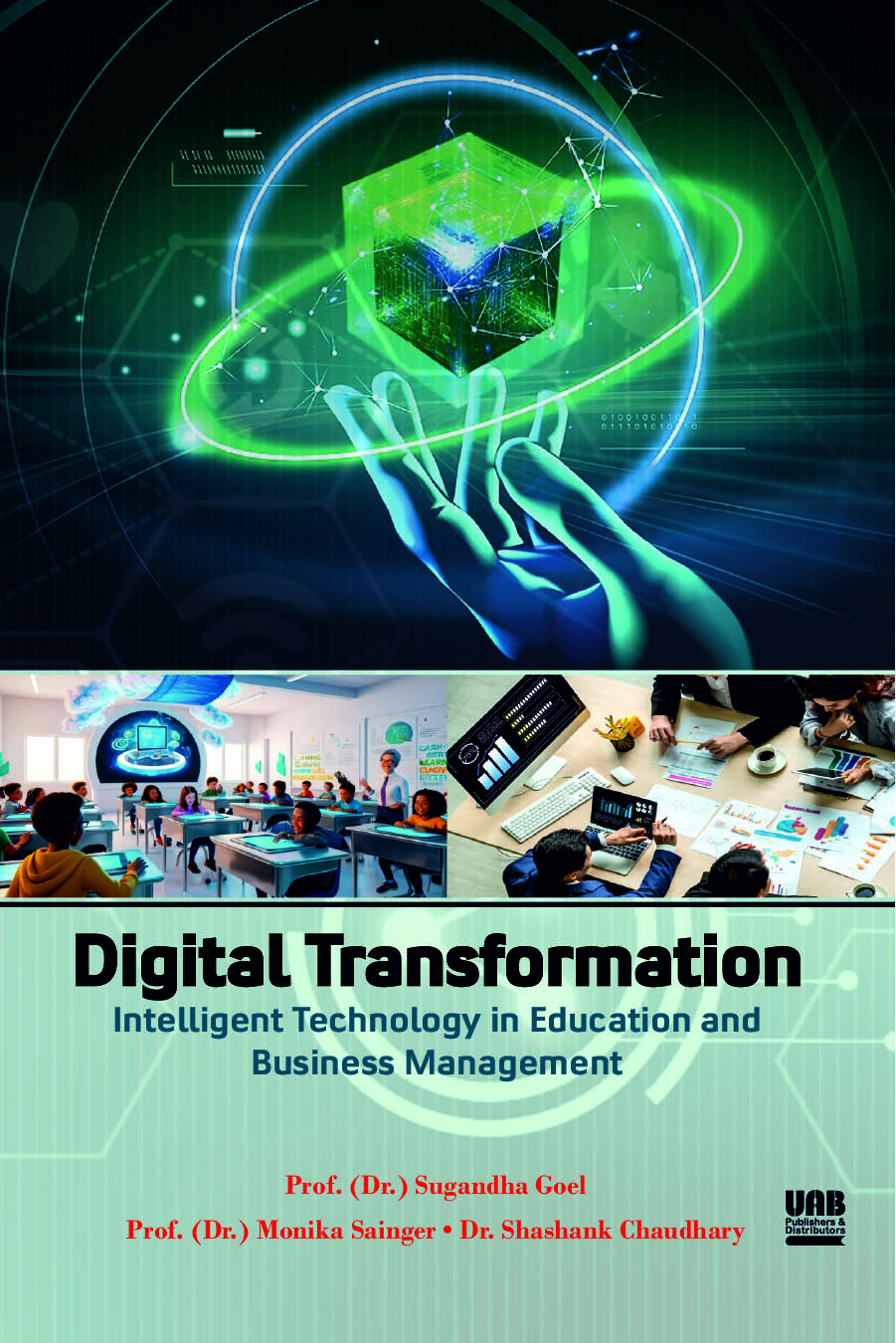
Digital Transformation: Intelligent Technology in Education and Business Management (e-book) by Prof. Dr. Sugandha Goel etal.
₹4,995
Digital Transformation: Intelligent Technology in Education and Business Management is a multidisciplinary volume that examines the transformative influence of intelligent technologies across the interconnected domains of business, technology, and education. It foregrounds the strategic integration of artificial intelligence, advanced analytics, automation, digital platforms, and data-driven decision systems in redefining organizational models, pedagogical frameworks, and managerial processes.
Description
Title: Digital Transformation: Intelligent Technology in Education and Business Management (e-book)
Contents
| Preface | Download Now |
| List of Contributors | Download Now |
| Chapter 1 | Sustainable Future Dr. Suman Lata |
|
| Chapter 2 | Navigating Employee Commitment: Retention Strategies for Organizations in the Gig Economy Era Dr. Swati Sharma |
|
| Chapter 3 | Digital Transformation in Human Resource Management: Challenges and Opportunities for Modern Organizations Dr. Mrinalini Pathak |
|
| Chapter 4 | Effectiveness of Google Classroom in Enhancing Internal Assessment Practices – Students’ Perception of Under Graduate Courses Dr. Nidhi Agrawal |
|
| Chapter 5 | Predictive Analytics in Artificial Intelligence for Financial Forecasting Dr. Preeti Varshney |
|
| Chapter 6 | Next Gen Human Resource in the Digital Era Dr. Rashmi Chaudhary and Anshu Kaushik |
|
| Chapter 7 | Leveraging Astrophysical Data for Intelligent Innovation: Economic and Technological Impacts on AI- Driven Industries Ananya Sahni and Dr. Sangeeta Sahni |
|
| Chapter 8 | Leadership 5.0 in the Age of Intelligent HR Analytics: Integrating Empathy, Ethical AI, and Data-Driven Innovation Dr. Saylee Karande, Ankur Srivastava and Rajkamal Upadhyaya |
|
| Chapter 9 | Reducing Psychological Distress in the IT Sector: A Mindfulness Meditation Program Study Drishti Singh |
|
| Chapter 10 | Impact of Digital Transformation on Microfinance Institutions (MFIs) in India Gautam |
|
| Chapter 11 | HR in the Age of Digital Transformation and Automation Kavita Vishnoi and Prof. (Dr.) Chanchal Chawla |
|
| Chapter 12 | An ML-Based Approach for MBTI-16 Personality Type Classification Using Orange Data Mining Madhusmita Jena |
|
| Chapter 13 | Empowering Employee Autonomy with Synergistic Leadership and Learning is a Key to Digital Transformation Success for IT Industry Supriya Bisaria |
|
| Chapter 14 | Algorithmic Management and Intelligent Work Culture: A Comparative Study of Hybrid Teams and Gig Economy Workers Teena Chaudhary |
|
| Chapter 15 | The Role of Linear Algebra in Machine Learning (ML) and Data Science (DS): A Review Amit Gupta |
|
| Chapter 16 | Navigating the Cybersecurity Landscape: From Awareness to Advanced Technologies Aryan Nair and Shweta Kumar |
|
| Chapter 17 | Study About Smart House Price Prediction: In Data Analytics and Machine Learning Astha Yadav, Priya Jaiswal and Varun Arora |
|
| Chapter 18 | Survey of Sand Cat Swarm Optimization Applications in Multiple Domain Dil Bhardwaj, Preeti Sharma and Prof. Varun Arora |
|
| Chapter 19 | Sustainability Computing and Green AI: A Study on Energy-Efficient Intelligent Systems Reeva Sharma, Girish Kumar and Kuldeep Kumar |
|
| Chapter 20 | AI-Based Personalized Time Management and Productivity Recommendation System for Students Using Behavioural Analytics Sangeeta Kumari, Mansi Sharma and Himanshu Vashistha |
|
| Chapter 21 | Digital Minds, Healthier Hearts: The Promise of AI in Mental Wellness Jayasri Tripathi and Dr. Sonal Kapoor |
|
| Chapter 22 | Intelligent Technology in Education and Business Management Dr. Jyoti Singhal, Abhishek Pratap Singh and Shikha Chaudhary |
|
| Chapter 23 | AI as the Catalyst for Operational Excellence Dr. Jyoti K. Tripathi, Dr. Monika Dixit Bajpai & Dhwani Garg |
|
| Chapter 24 | The Role of Cloud Computing in Real-World Application: A Quantitative and Strategic Analysis (2025–2030) Kanchan Mishra |
|
| Chapter 25 | Prediction of Student Exam Performance Using Data Mining Classification Algorithms Karan Singh and Priyanka Bhandari |
|
| Chapter 26 | A Scalable Fog–Cloud Integrated Architecture for Real-Time Internet of Things Applications Karishma |
|
| Chapter 27 | AI Automation: Emerging Trends, Opportunities, and Global Impacts Khushi Rajput and Ashwini Kumar |
|
| Chapter 28 | A Formal Study of Information Loss in Quantum Measurement under Finite Precision Krishan Kansal and Pawan Pandey |
|
| Chapter 29 | Dermatology Disease Classification Kritika Rana |
|
| Chapter 30 | A Security Management Model for Multi-Tenant Cloud ERP Systems Md. Altamash |
|
| Chapter 31 | Cardiac Arrhythmia Detection Using WEKA Data Mining Tool Megha Mehta |
|
| Chapter 32 | Cyber Attacks and Their Real-World Implications: A Survey of Threats and Defences Mohd. Alam Khan |
|
| Chapter 33 | Deep Learning Approaches for Text Classification, Natural Language Processing, and Data Mining Savita and Dilip Kumar |
|
| Chapter 34 | Sentiment Analysis & Emotional AI in Employee Experience at Work Shalini Verma, Sandeep Vishwakarma and Dr. Kumud Kundu |
|
| Chapter 35 | Study About Butterfly Optimization Algorithm for Smarter Solutions Neha Singh, Suhana and Varun Arora |
|
| Chapter 36 | Research on Robotic Arm with Computer Vision for Object Detection and Pickup Operation Vivek Kumar, Avantika Sharma, Manish Singh and Neha Bhatt |
|
| Chapter 37 | Towards Robust Detection of Credit Card Fraud: A Machine Learning Perspective Piyush Bhardwaj |
|
| Chapter 38 | Green Data Centers: Sustainable Practices for Energy Efficient IT Infrastructure Priyanka Bhandari and Karan Singh |
|
| Chapter 39 | Intelligent Smart Systems and AI-Powered Educational Technologies in Higher Education Ecosystems Dr. Ravi Kant Verma |
|
| Chapter 40 | Explainable AI in Intelligent Tutoring Systems: Enhancing Trust and Transparency in Higher Education in India Dr. Reena Agarwal |
|
| Chapter 41 | Optimizing Facial Expression Recognition with PSO-AOBL: A Balanced Approach to Accuracy and Computational Efficiency in Edge Environments Shweta Sharma and Prof. Ashok Kumar |
|
| Chapter 42 | Gender, Disability, and Minority Inclusion in Education: A Qualitative Analysis of Challenges and Policy Perspectives Aysha Malik |
|
| Chapter 43 | Global Competencies and 21st Century Skills Bhavna Aggarwal |
|
| Chapter 44 | Influence of Social Infrastructure and Safety on Girls’ Access to Education in Rural Villages Dr. Neetu Chawla and Bhavika Sharma |
|
| Chapter 45 | Curriculum Innovation for Future Skills: A Mixed-Methods Study on Teachers’ Perceptions and Practices Dr. Anita |
|
| Chapter 46 | Universal Design for Learning (UDL) in Inclusive Education Settings: Enhancing Engagement and Achievement among Diverse Learners Dr. Shweta Tyagi |
|
| Chapter 47 | Outcome-Based Education (OBE) And Performance Indicators Km. Garima |
|
| Chapter 48 | Enhancing Educational Equity: Adaptive Learning Platforms for Neurodiverse Children with Special Needs Gerin Rachel Lukose and Dr. Smriti Malhotra |
|
| Chapter 49 | Gender, Disability, and Minority Inclusion in Education Dr. Hemlata Kashyap |
|
| Chapter 50 | Inclusion: Past, Present and future of Education Jyoti Sharma, Kamini Sharma and Monika Mishra |
|
| Chapter 51 | Examine the Impact of Digital Educational Resources on School Climate and Academic Performances Kalpana Nagar and G. S. Prakasha |
|
| Chapter 52 | Curriculum–Assessment Alignment and Its Role in Achieving Intended Learning Outcomes: Evidence from B.Ed. Programs in Delhi NCR Kirti Chaudhary and Nazneen Khan |
|
| Chapter 53 | Artificial Intelligence in Education: Transforming Teaching and Learning Practices Pankaj Kardam and Tanishka |
|
| Chapter 54 | Effectiveness of Outcome-Based Education in Developing Higher-Order Skills Parul Tyagi |
|
| Chapter 55 | Assessing Competency-Based Education Drivers that Strengthen Employability Skills within NEP 2020 Implementation Rachna Vats and Dr. Shiwangi Sharma |
|
| Chapter 56 | Promoting Equity & Access for students with Gender & disability in Inclusive Education Dr. Rajesh Kumar Sharma |
|
| Chapter 57 | Alternative Assessment in Higher Education: Portfolios, Rubrics, and Peer Evaluation as Catalysts for Outcome-Based Learning Rini Srivastava |
|
| Chapter 58 | Co-Operative Learning as a Pedagogical Approach to Modern Curriculum Design and Future Skills Ritu Rani and Dr. Indrani |
|
| Chapter 59 | Competency-Based Education in the Present Scenario Dr. Ritu Tyagi |
|
| Chapter 60 | Using Open Educational Resources (OER) To Enhance Student Classroom Engagement: An Action Research Study Dr. Roma Singh, Dr. Grishma Shukla and Dr. Rajani Chopra |
|
| Chapter 61 | Digital Community-Based Rehabilitation: Bridging the Digital Divide and Strengthening Inclusive Education through Parental School Collaboration Roopal Mahajan |
|
| Chapter 62 | The Role of Metacognitive Beliefs in Internet Addiction and Digital Distraction among the College Students Shweta Gupta and Dr. Shivani Yadav |
|
| Chapter 63 | Gender, Disability, and Minority Inclusion in Education: Aligning Inclusive Practices with NEP 2020 Dr. Veena Dalania and Rekha Gupta |
|
| Chapter 64 | Fostering Inclusive Education through Stakeholder Engagement Viditi Rastogi |
|
| Chapter 65 | A Study of the Impact of Community and Stakeholder Engagement on Teachers’ Job Satisfaction in Inclusive Education Schools of Ghaziabad, Uttar Pradesh Dr. Vinita M. Chaudhary |
|
| Chapter 66 | Nurturing Innovations in the Classroom: Art-Integrated Pedagogy Yogita Mittal and Prof. Vijay Jaiswal |
Additional information
| Author | Dr. Shashank Chaudhary, Prof. (Dr.) Monika Sainger, Prof. (Dr.) Sugandha Goel |
|---|---|
| e-ISBN | 9788199458635 |
| Publisher | Universal Academic Books Publishers & Distributors |
| Year | 2026 |
| Pages | xxii + 712Pp |
Related products
-

-
Sale!
Environmental Degradation of Industrial Composites
- Original price was: ₹31,646.₹25,316Current price is: ₹25,316.
- Add to cart
-
Sale!
-
-
Sale!
A Problem-Solving Approach to Aquatic Chemistry
- Original price was: ₹20,914.₹16,732Current price is: ₹16,732.
- Add to cart
-
Sale!
-
-
Sale!
Chemical Thermodynamics of Selenium
- Original price was: ₹31,646.₹25,316Current price is: ₹25,316.
- Add to cart
-
Sale!
Reviews
There are no reviews yet.